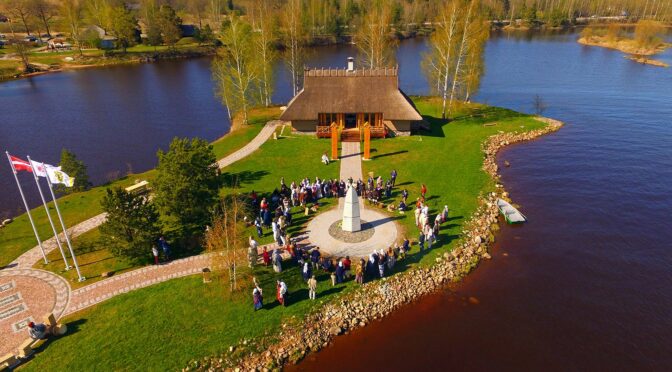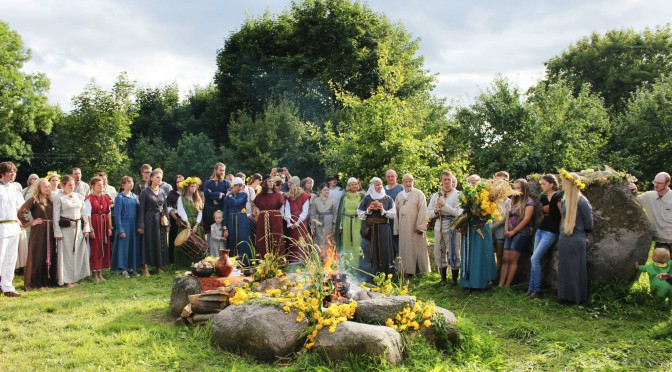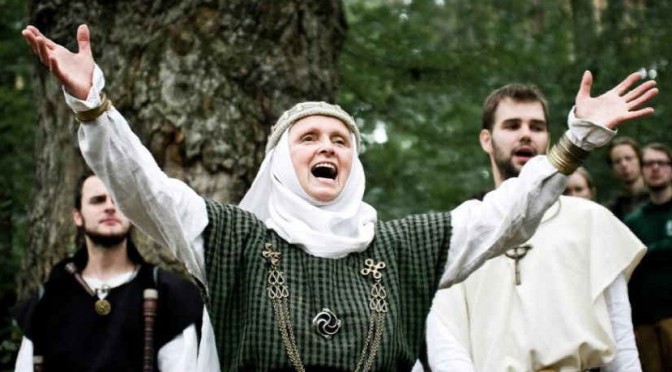
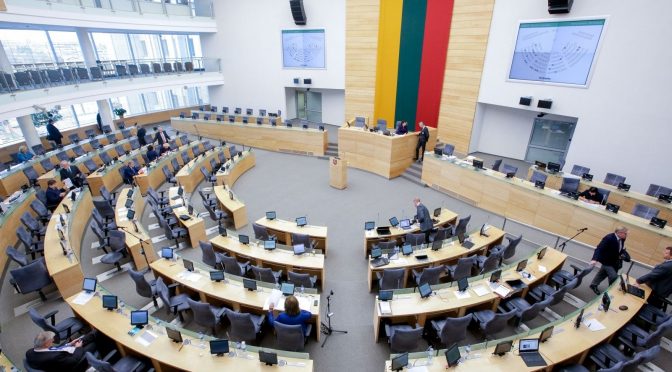
Declaration № 2024-08-1 “Regarding the Recognition of the Sacred Sites of International Significance” has been adopted by the European Congress of Ethnic Religions (ECER) on August 8, 2024. It confers the status of to nine sacred sites in Europe.

Declaration № 2024-08-1 “Regarding the Recognition of the Sacred Sites of International Significance” has been adopted by the European Congress of Ethnic Religions (ECER) on August 8, 2024. It confers the status of to nine sacred sites in Europe.
We, the delegates from 17 different countries convened at the European Congress of Ethnic Religions in Rīga, Latvia, on June 30, 2023, join our voices together to make the following declaration:
We, the undersigned, represent religious communities upholding the traditional, ethnic religions of diverse peoples of Europe. We hold deep reverence for our ancestors, the Gods and Goddesses they worshiped and the worldview and values that they bequeathed to us. Our spiritual traditions are inseparable from our traditional culture, and both require support and protection.
We call on all the governments of the nations of Europe and the European Union to grant our religions the same respect and privileges that are accorded to other religions in European societies and legal systems. We ask for the following specific measures:
1. Special governmental protection and support as a part of indigenous culture, that is humanity’s cultural heritage;
2. A legal status protected by the state (including determining it by a special law) which is not evaluated and compared according to the criteria of other religions;
3. Perform ceremonies at, and use the ancient sacred sites, for example, if there is no church built on it, while respecting the rules of protection for the archaeological sites;
Life cycle rites must be accessible according to our traditions and protected;
4. Perform wedding ceremonies with legal authority in countries where the governing law recognizes these ceremonies done by recognized religions;
5. Practices towards the end of life, including but not limited to, visiting the ill and spiritual care, cooperation with hospitals, cemeteries and funerary rituals according to our traditions must be protected;
6. Our festival and celebration dates enshrined in law and shown in calendar;
7. When there is religious education in public schools, guarantee the freedom of choice to either abstain from, or participate in the religious studies depending on the cultural heritage of the country;
8. Chaplaincy — right to appoint the chaplains;
9. Broadcast time slot in public media;
10. Tax relief or exemption for our religious organization;
11. Safeguarding us from the influence of globalization consequences, persecution, and discrimination by other religious organizations due to their cosmopolitan status;
12. Institutions must respect the local sacred languages and traditions, taking us into account as the local identity of the indigenous European people;
13. Safeguarding the nature around the sacred places;
14. The sacred natural sites must be a category of protection on its own — combining both natural sites and archaeologic sites — this allows using such places for the practice of traditional religions and protecting them from harmful human activity;
15. Respect of sacred land, and protection from mining companies, resource and land expropriation;
16. Igniting, maintaining, observing and using sacred fires and bonfires in open-air setting during our ceremonies must be permitted and protected as part of our tradition and religious freedom in harmony with nature’s needs;
17. When there is evidence of discrimination, or institutional silence towards requests of recognition of ethnic religions, we as the ECER, will encourage the local government in writing from the Presidency of the Congress, calling upon their willingness to protect and respect the rights of everyone by responding to the request.
It is essential that our governments and the European Union guarantee certain rights and protection for religions based on ethnic cultures within their homelands. By doing so, they can ensure the preservation and continuity of our ancestral traditions. We believe that the recognition and protection of our ancient religions will contribute to the preservation of our unique identities and the cultivation of a more inclusive society. Together, let us strive for the acknowledgment and safeguarding of our ancient religions, rooted in our ancestral cultures, so that they may thrive for generations to come.
Mēs esam nu kungi mūsu dzimtajā zemē, Mēs varam nu paši sev likumus lemt:
Tā zeme ir mūsu, ir mūsu — jā gan! — Mēs negribam lūgt to, kas mūsu, bet ņemt!
We send this message in kinship, love, and respect.
Member organizations (represented by):
Latvijas Dievturu sadraudze, Latvia (Andrejs Broks, Ansis Bērziņš, Uģis Nastevičs)
Associazione Tradizionale Pietas — Pietas Comunità Gentile, Italy (Giuseppe Barbera, Florian Ransford, Lorenzo Facciuoli, Varveri Basilio Salvo, Yuri Gavriliouk)
Groupe Druidique des Gaules, France (Manquat Jean Lionel)
Об`єднання рідновірів України, Ukraine (Галина Лозко, Ганна Андрощук)
Związek Wyznaniowy Rodzima Wiara, Poland (Judyta Król, Piotr Brzeziński)
Senovės baltų religinė bendrija Romuva, Lithuania (Inija Trinkūnienė, Benas Barzdžius)
Sjamanistisk Forbund, Norway (Kyrre Gram Franck, Kjell Henrik Gove, Knut Fuglesteg)
Slovanský kruh, Czech Republic (Lukáš Pajer, Marianna Gorroňová, Jakub Krejčíř)
Societas Hesperiana Pro Cultu Deorum, Italy (Federico Fregni, Giuliano Gregorio)
Werkgroep Traditie Vzw, Flanders (Belgium) and The Netherlands (Brenda Lioris, Elisabeth Overgaauw, Heide-Marie Piette, Luc Janssens, Nina Bukala, Thomas Slembrouck, Jorres De Vriendt)
Ύπατο Συμβούλιο των Ελλήνων Εθνικών, Greece (Ιωάννης Μπαντέκας)
Observer organizations (represented by):
Arktisk Sjamansirkel, Norway (Øyvind Siljeholm)
Česká pohanská společnost, Czech Republic (Giuseppe Maiello)
International Center for Cultural Studies, United Kingdom (Jacob Moss)
Latvju dievturu sadraudze, United States (Andris Rūtiņš)
Lietuvių etninės kultūros draugija, Lithuania (Virginijus Kašinskas)
Mythology Corner, United States (Ghanasyam Akella)
Slované, Czech Republic (Nami Maria Lada, Svatava Kollmannová)
Väkikunta, Finland (Patrick O’Rourke)
Ύπατο Συμβούλιο Ελλήνων Εθνικών Ρόδου – “Τελχινίς”, Rhodes, Greece (Βαγγέλης Αλεξανδρής, Ιωάννης Μπαχάς, Φοιβαίος Εμμανουήλ Αθανασούλας)
This Declaration is also supported by individuals:
Michael Strmiska, Ph.D., SUNY-Orange, USA, scholar
Prudence Priest, Romuva Ambassadress to the USA
後藤正英, Ph.D., Japan, scholar
…
The new board of the ECER elected on Jun 30, 2023 in Rīga, Latvia:
Brenda Lioris
Giuseppe Barbera
Giuseppe Maiello
Inija Trinkūnienė
Ιωάννης Μπαντέκας
Kyrre Gram Franck
Uģis Nastevičs
Running for president:
Inija Trinkūnienė
Uģis Nastevičs
The elected president:
Uģis Nastevičs
Attention! The deadline of application was June 2, 2023. Please make sure to send in the attachment the bank document that proves the initiated transfer of the registration fee by this date to the e-mail address dievturi@gmail.com. The applications after this date shall not be reviewed.
2023/06/29–2023/07/02
The purpose of the European Congress of Ethnic Religions (ECER) is to serve as an international body that will assist Ethnic Religious groups in various countries and will oppose discrimination against such groups. By Ethnic Religion, we mean religion, spirituality, and cosmology that is firmly grounded in a particular people’s traditions. In our view, this does not include modern occult or ariosophic theories/ideologies, nor syncretic neo-religions.
The first European Congress of Ethnic Religions took place in Vilnius (Lithuania) in 1998, the 10th Congress was held in Rīga-Jūrmala-Sigulda (Latvia) in 2007. We are privileged to announce that the 18th Congress returns to Latvia. We are looking forward to see you in Rīga and Lokstene during the 4 days of the Congress (June 29 – July 2, 2023) in Latvia.
Please, feel free to follow our news and updates on social media sites — @Dievturi —, and use the hashtag #ECER2023 when publishing or looking for the information about the Congress.
More information: https://sites.google.com/view/ecer2023/
Here is the application form link: https://forms.gle/RZtEpAaFtJkj8Aqw5
Two years ago, after the Lithuanian Parliament (Seimas) had refused to grant Romuva official status as a religion, I wrote a statement on behalf of the ECER which was published on this website, in which I stated:
“In the 21st century, no government should have the right to officially recognize some religions, and not others. Freedom of religion should apply to all religions equally, period. The ECER affirms our support of Romuva, and we will stand in solidarity with our Lithuanian sisters and brothers in any further efforts to bring this matter before such bodies as the European Court of Human Rights in Strasbourg, the United Nations Human Rights Council in Geneva, and the UN’s Permanent Forum on Indigenous Issues in New York. We invite all peoples of good conscience to join us in these efforts.”
On 8 June of this year, the European Court of Human Rights – in a long-awaited decision – did, in fact, agree and ruled that the Seimas was in violation of Articles 9, 13 and 14 of the Convention for the Protection of Human Rights and Fundamental Freedoms. The Court found that the Lithuanian Parliament’s decision was in error as a result of:
• Discrimination
• Denial of State recognition to a pagan religious association meeting eligibility criteria, on grounds incompatible with the State’s duty of neutrality and impartiality
• Domestic law lacking safeguards against arbitrariness in decision making performed by a political body (the Parliament)
• Involvement of a Catholic authority in parliamentary procedure
It is worthy of notice that the Seimas’ decision against Romuva appears to have been strongly influenced by a letter from the Lithuanian Bishops’ Conference which was sent to a member of the Seimas, and then distributed widely to other members of the Lithuanian Parliament. In that letter, the bishops suggested that recognizing Romuva could de-stabilize the relationship between the predominantly-Catholic Lithuanian population and the Church. The letter from the bishops also stated that the allegedly surviving fragments of [Romuva] were nothing more than “superstitions and peasants’ customs, with a shade of magic”, and that their importance to Lithuanian identity was exaggerated.
The Court’s ruling appears to pave the way for pagans seeking legitimization in other European countries in which dominant forms of Christianity (such as Catholic or Orthodox) prevail, to mount challenges to any objections from the mainstream religions.
The European Congress of Ethnic Religions continues to stand strong in our support of Romuva’s further efforts to enforce in Lithuania the decision of the European Court of Human Rights, just as we support the implicit and moral rights of other European ethnic religions to assert their viable existence, and to claim the same official recognition that their respective nations may grant to any other religions.
Andras Corban-Arthen
President, European Congress of Ethnic Religions
Dear friends,
A few months ago we sent you a letter to announce that the next Congress would take place this September in Riga, Latvia. As you might expect, because of the difficulties involving the COVID19 pandemic, there is no other choice but to cancel the event for this year.
We hope that the situation will be very different in 2021, and we will continue our conversation with our friends from Latvia about the possibility of still having the next Congress there.
I hope that you, your families and communities are all in good health, and I trust we will be able to see each other again soon.
Deep Peace,
Andras Corban-Arthen,
president on behalf of the Governing Council
The National Awards of Equality and Diversity in Lithuania were presented on June 4, 2020. We are proud to announce that the prize for diversity of religions and beliefs went to the old Baltic religious community of Romuva. The community has been praised for its determination to defend the rights of its religious community and for recognition by the state. Romuva appealed to the European Court of Human Rights and noted that although it met all the requirements of Lithuanian law, the Seimas did not grant state recognition to this religious community. ECER wishes to support Romuva with their demand for recognition and would like to congratulate Romuva on this deserved prize.

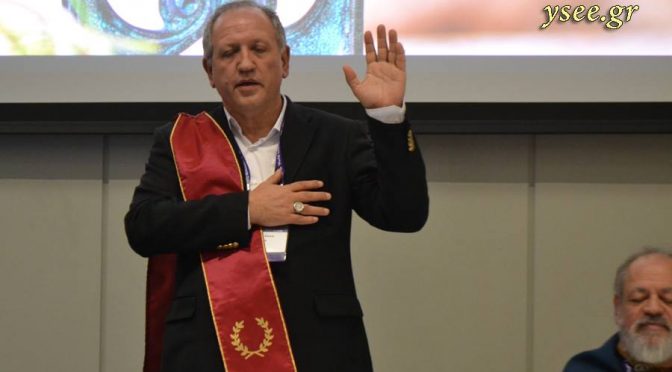
The ECER mourns the passing of Vlassis G. Rassias, one of our founders and a member of our Board of Directors. Vlassis, the leader of the Supreme Council of Ethnic Hellenes (YSEE), was renowned as an author, speaker, and activist for the restoration of the Hellenic ancestral religion, as well as an advocate for other indigenous, ethnic religions throughout Europe. I grieve, personally, the loss of a dear friend and colleague, someone whom I deeply appreciated, respected and admired throughout the decade we worked together. This is a photo of Vlassis addressing the Parliament of the World’s Religions in Toronto, Canada last November, as part of a panel discussion that he, Inija Trinkuniene of Lithuania, and I presented there. On behalf of the ECER, I send our deep condolences to his family and community — we are all so much richer for having had Vlassis as part of our lives.
Andras Corban-Arthen
President, European Congress of Ethnic Religions
Those we love don’t go away, they walk beside us everyday. Vlassis, you joined the ancestors’ so early, we grieve a lot, but your work for the rights and freedom of European ethnic religions will stay in our hearts forever!
Inija Trinkūnienė on behalf of all “Romuva” community
This morning a mate and long-standing friend informed us that Vlassis Rassias, the head of the big heathen community of Greece YSEE (Ellenic’ Council) is passed away.
The news, unexpected, came like a slap.
While I’m writing i don’t know how and why he has died yet.
Immediately many memories of his strong personality and of our various meetings, happened in a time frame of veteen years, reached my mind.
Different occasions, between different people and lands, but similar at the same time, along our Europe roads.
Contacts and congresses happened pursuing a common goal: the right to the legitimacy and dignity for those seeking and nding answers and cohesion in the ancient and eternal religiousness of our respetive Ancestors.
The rst coming to my mind are the images of our last meeting, not lacking of dialectic, but always respectful and with the aim of the common good: it was in occasion of the last E.C.E.R. Congress (former W.C.E.R.) organized in Rome on April 2018 by the M.T.R. coinciding with the Foundation of Rome celebrations MMDCCLXXI a.U.c.
However our pasti is old timed.
With Vlassis, indeed, we were in touch from the beginning of the century thanks to the tireless witness of the Roman-Italic Tradition that was Salvatore Ruta, cofounder and princeps of the M.T.R. of the origins.
Through Salvatore, with Vlassiv we enstablished a very hearty connection based on mutual exchange, by virtue of the common aim of making the Religion of our Ancestors live. Actually his trip to Messina and the meeting with Ruta were for Vlassis the starting point for the development of his next productive path in the Ellenic land, with his Y.S.E.E.
Then the new technologies spread in those years, internet and the debate blogs, helped our exchanges and meetings: Vlassis on 2006 called me to concelebrate at his great event: the Prometeia, organized in Greece on the Mount Olympus, in occasion of the Summer Solstice. I embraced the invitation leading a M.T.R. delegation in the Ellenic land.
After that journey – because of the surprise of attending a Solstice celebrated by an unexpected crowd of people, men, women, erderly, children, a whole community, and because of the interesting organizational and doctrinal insights of those days with Vlassis on the Moun Olympus and in Athens – that I arrived to a method decision: time had come that we, Italian heathens, as well, came from our ivory tower and opened up to the world.
So I owe to Vlassis the turning point that i gave to the M.T.R., rst one in Italy to undertake international relations.
So we take part to the W.C.E.R. congress on 2007 in Latvia, in Riga and Jurmala: even in this occasion, between the Y.S.E.E. mates and us, important af nities and strong correspondences emerged coming from the common classical culture. Then we met in Poland and, after a few years, in Lithuania, in Vilnius on 2014 and in Prague on 2016. Vlassis gave us the courtesy of a friendship visit, as well, in our hedquarters in Rome, to strengthen the ancient bond. Dear Vlassis, let me say that your long and constant work for the bene t of the current Greek and European paganism has been essential. we hope that others will know how to seize your important baton and that they will be worthy of raising the torch high, always keeping the sacred re burning. May the Gods be favourable to your new journey undertaken, and may the ground be light for you.
Daniele Liotta
MTR President
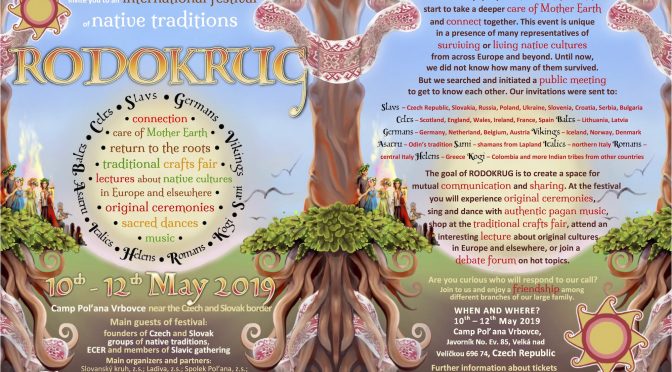
Please, accept our invitation to the RODOKRUG – a meeting of people, Earth and traditions of all nations.
The planet Earth calls us and wants us to think about what we are going to give to our children. If your ancestors spoke to you and you feel their voice in your hearts, then come. We will connect our forces in a united circle with our songs, prayers, dances and acts of wisdom.
The key is a connection between man and the planet. Our native traditions and their people. They teach us about values like Man, Nature, Family, LOVE, connection with sacred powers and mutual friendship. Our gods and ancestors protect us on our journey.
Please, accept this invitation to the new festival Rodokrug – a space, created for sharing our native traditions, which were passed to us by our dear ancestors.
We are inviting you, because:
Come, and if you can, bring your TRADITIONS, CEREMONIES and RITUALS, SONGS and DANCES – which you carry inside yourselves. Let’s share them with each other. Come and talk to people at a lecture. Or come to support this meeting just with your very presence. Everyone is welcome.
Together we will find the key to a happy life in a family, community and connection of the spirit and universe.
We are looking forward to meeting you.
The RODOKRUG festival will be held from 10th to 12th of May 2019. The place of meeting is Camp Pol’ana Vrbovce near the Czech and Slovak border.
We are all one circle, one family, and our roots touch each other.
SLAVA and thanks to our native gods, Mother Earth, ancestors and powers of Nature.
On behalf of the whole team of RODOKRUG festival Zdenek Ordelt, leader of the festival organization.
Web: https://www.rodokrug.com
FB: https://www.facebook.com/rodokrug
Republished from Icelandmag.is
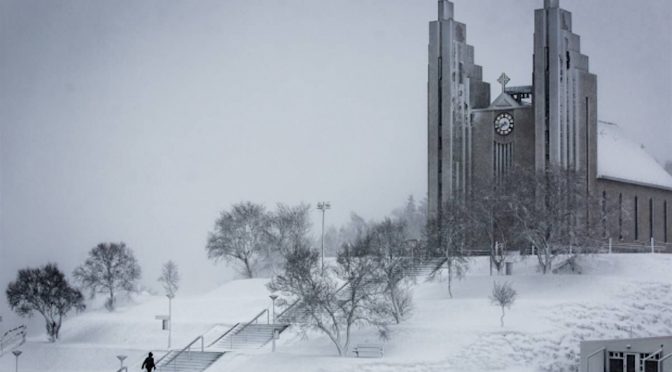
The National Church of Iceland continues to lose congregants. The latest data on religious registration from Registers Iceland reveals that the church lost 2,029 members during the first nine months of 2018. The State Church is the only of the five largest religious congregations to lose members this year.
Continue reading Icelanders abandon National State Church, as old pagan Ásatrú continues to grow