Category Archives: NEWS

The Athens Declaration of the European Congress of Ethnic Religions (2025)

«The Contribution of Ethnic Religions to the formation of European Identity»

European ethnic traditions and religions have largely shaped the character and worldview of Europeans and are the foundation of European culture, which encompasses almost everything, from folk customs and science to art and philosophy.

These traditions are not simply remnants of the past, but a living, powerful, and historically validated framework that has positively and continuously influenced the development of European societies throughout history. At the same time, it is an opportunity for many people to awaken and discover their ethnical cultural uniqueness.

Ethnic religious traditions are more than spiritual belief systems; they serve as a framework for social cohesion, cultural continuity, and collective memory. Through rituals, symbols, and narratives, they create bonds within communities, fostering a sense of belonging and shared identity.

Ethnic religions are the driving force behind the creation of ethnicities, which may speak different languages but describe and interpret the Cosmos with a similar worldview. European ethnic religions are one of the main forces that created our identity and are responsible for the existence and preservation of a European common ethnicity.

Ethnic religions and traditions are guardians, preservers and weavers of intangible cultural heritage, agents of spiritual renewal in modern Europe, and act as a vital catalyst for social cohesion. As they are cultivated and strengthened, they simultaneously revitalize communities by promoting growth in areas such as science, education, and civic engagement.

As historic sources document, after the often-forced replacement of the ethnic religions by monotheisms, several countries have experienced a decline in ethical and spiritual integrity, evolving into systems marked by pervasive corruption and weakened moral foundations. In these societies appearances and material success are often valued more highly than sincerity, honor, and the deeper principles that once guided traditional way of life that stresses authenticity. A revival of ethnic religions could ensure the restoration of this character traditionally embedded in culture and give European spirituality a harmonious, healing and sustainable effect, as the renaissance has proven the change that can occur when traditions emerge in the forefront.

Given Europe’s historical background and in light of the significant changes that will determine its future, it is now more crucial than ever to protect, study, and promote these religions and traditions institutionally, going beyond mere preservation.

In this way, we can draw on their inherent wisdom to address the challenges of our time and ensure a future for Europe that is both rooted in its heritage and dynamics.

WHY DO WE DEFEND ETHNIC RELIGIONS AND TRADITIONS?

-Because they offer each people a unique vision for understanding themselves and interacting with the world.
-Because they integrate humans into the cyclical time of constant re-creation without the fear of death.
-Because they create religious pluralism that is reflected in the world of the Gods and Goddesses as an ethnosphere.
-Because they create the historical continuum of Tradition through which the social condition of Identity is freely expressed, thus allowing the same essence to take on infinite valid forms.
-Because they restore meaning to life through behavioral patterns that strengthen collective life and cultural creation for the benefit of the community.
-Because they open up different ways of approaching the numinous in each different culture, without demanding any kind of ownership for themselves, but respect and accept as equally valid the indigenous narratives that developed effortlessly by interpreting nature with logic.
-Because they are the ones that demand the greatest honor for mortal beings, to approach and revere the sacred, not through self-punishment but through the spiritual elevation provided by mysteries and rituals.
-Because they are the creative force behind the cultural creation known as ethnos. Without them, the ethnos would be reduced just to a random group of atomic individuals, without common content, by the monocracy of globalization and to mere consumers or interchangeable labour force.
-Because they place responsibility, a fundamental element of any justice system, in the place of forgiveness.

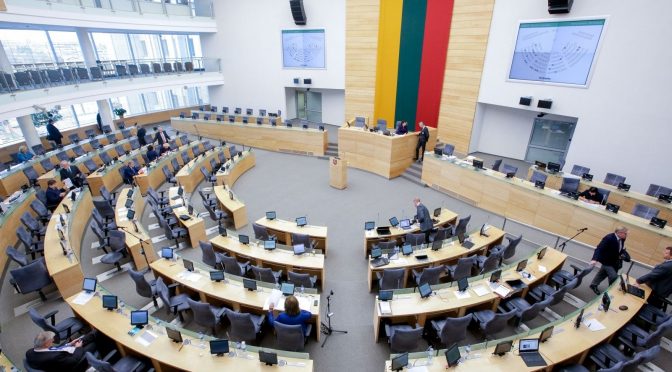
From Athens, on October 4, 2025, representatives of 16 organisations from 14 countries are joining forces to declare our respect for traditional European religions.

We recognize the value of our ancestors, as well as the worldview, and traditions they have passed down to us. Our culture and spirituality are inextricably linked to our religions and traditions and must be protected.

We appeal to all European governments and European Union institutions to recognize our religions and grant them the same respect and privileges enjoyed by other recognised religions in European legal systems.

Therefore, we request the following:

1) Full recognition of the ethnic religions and traditions of Europe, acknowledgment of their historical and cultural role in the formation of the ethnos, and establishment of a special legislative framework for specific issues such as the performance of marriages and naming ceremonies with full legal validity.
2) Institutional participation of the ethnic religion’s leadership in official state events, inaugurations and wherever else required.
3) Establishment of a legal framework for the protection of all rituals, customs and the days of celebrations of the ethnic religion associated with major life events: from birth and marriage to end-of-life care (care for the sick/elderly and burial).
4) Establishment of a legislative framework for the unhindered operation of religious organizations (tax breaks, state funding, direct sanctions on individuals or other religious organizations that oppose, slander or defame or turn in any way against the representatives of the ethnic religion).
5) Legislative initiative for the designation of the sacred temples, epiphanic places and/or groves of the ethnic religions as strictly protected religious sites—rather than merely cultural or archaeological sites—including their surrounding environment.
6) Securing the right of ethnic religions to access and use the sacred spaces that fall under state jurisdiction for the performance of religious rites and other activities, with absolute respect and unwavering adherence to regulations.
7) Respect and recognition of sacred languages and traditions as fundamental elements of ethnic identity.
8) Adopt best practices from other nations on recognition and protection.
9) Review of the content of educational textbooks and programs at all levels, to ensure appropriate respect and proper representation of ethnic religions.
10) Ensuring the unhindered right to abstain from religious education classes, without social stigmatization or any obstacle for those who do not wish to attend.
11) Recognition of the sanctity of Nature and adoption of measures to prevent its systematic and deliberate exploitation, including the preservation of sacred sites, forests and venerable heritage trees from cutting or disturbance.
12) Clarify the meaning of traditionality which is embodied and represented only by ethnic religions which are indigenous in their respective countries.
13) As far as to the national law extends, the traditions of ethnic religions must be recognized as part of the local traditional culture.

Member organizations (represented by):

Ύπατο Συμβούλιο των Ελλήνων Εθνικών, Hellas (Κώστας Κεχαγιάς, Γιάννης Μπαντέκας, Ελένη Πετρή, Ελένη Ξάνθη, Αναστάσιος Καρακώστας, Σοφία Βλαχούλη, Αιμιλία Ματθέ, Παναγιώτης Κακκάβας, Νίκη Ρήγα, Δημήτριος Μητσάτσος, Καλλιστώ Τσολομύτη, Χρήστος Γκατζόγλου, Αριστοδίκη Κυριακή Λαμπίρη, Αμφικτύων Ευστάθιος Κεφάλας, Παναγιώτα Διοτίμα Παπουτσή, Δημήτριος Τακτικός, Σοφία Σουλιώτη, Χρήστος Χρήστου, Ιωάννης Κοσμόγιαννης, Πέτρος Νικολάου, Δημήτριος Παππάς, Βασίλειος Κατσιούπας)
Associazione Tradizionale Pietas, Italy (Giuseppe Barbera, Mattia Zaniboni, Filippo Cavatore, Lorenzo Facciuoli, Anselmo Perrotta, Yuri Gavriliouk)
Groupe Druidique des Gaules, France (Jean Lionel Mamquat, Jean MarcDuvette, ValérieParrat, Alexandra di Genova di Salle)
Latvijas Dievturu sadraudze, Latvia (Uģis Nastevičs, Eva Mārtuža, Andrejs Broks, Daina Kazāka)
Об`єднання рідновірів України, Ukraine (Лозко Галина Сергіївна, Дериведмідь Володимир Дмитрович)
Senovės baltų religinė bendrija Romuva, Lithuania (Ugnė Trinkūnaitė, Benas Barzdžius)
Sjamanistisk Forbund, Norway (Kyrre Gram Franck, Gro Hilseth Adriansdatter)
Slované, Czech Republic (Giuseppe Maiello)
Werkgroep Traditie Vzw, Belgium (KoenraadLogghe, Thomas Slembrouck, Brenda Lioris, Jorres De Vriendt)
Związek Wyznaniowy Rodzima Wiara, Poland (Judyta Król, Piotr Brzeziński)
Ύπατο Συμβούλιο των Ελλήνων Εθνικών Κύπρου, Cyprus (Γιώργος Κωνσταντίνου, Ευδοκία Ιωάννου)

Observer organizations (represented by):

Forn Sed Norge, Norway (Ingvild Linéa Bråthen, Audun Mehl)
Forn Siðr, Denmark (Camilla Winther Bang, Monika Ylfa Steensdatter)
Kredenn Geltiek, France (Erwan Le Bars)
Mythology Corner, United States (Ghanasyam Akella)
Rodný kruh, Slovak republic, Kokava nad Rimavicou (Rodan Švický, Miroslav Žiarislav Švický, Rastislav Štefanák)
Θύρσος – Οίκος Ελλήνων Εθνικών, Hellas (Ευάγγελος Κιούσης, Γιώργος Δημόπουλος)

This Declaration is also supported by individuals:

Nephelie Skarlatos, Hellas, scholar
Stian Sundell Torjussen, Associate Professor, University of Inland Norway, Hamar
Rasa Pranskevičiūtė-Amoson, Associate Professor, Vilnius University, Lithuania
Φωτίου Ευγενία, Associate Professor, University of Crete, Hellas
Σμαροπούλου Μαριλένα, Hellas
Paul Zurkinden, Switzerland
Antoine Teyssier, France
Ευθύμιος Κανιώρης, Hellas

The 19th European Congress of Ethnic Religions (ECER) in Athens

The Supreme Council of Ethnic Hellenes (YSEE), as the representative body of the Hellenic Ethnic Religion, is honored and pleased to announce the hosting of the 19th European Congress of Ethnic Religions (ECER) in Athens, Greece, from October 3rd to 5th 2025, under the theme: The contribution of Ethnic Religions to the formation of European identity.
The international organization ECER has already held 18 successful conferences, the 7th of which took place in 2004 in Athens under the auspices of the YSEE. ECER has also a rich activity aimed at assisting and promoting European religious organizations of ethnic traditions and religions as well as combating discrimination against them.
The aim and focus of the conference are to highlight aspects of European traditions and ethnic religions that contribute to, reinforce and strengthen the sense of European citizens of belonging to a shared cultural tradition and the way in which this is brought to light and consolidated in the contemporary European consciousness.
The thematic axes of the conference are:

Ø Commonalities and differences among ethnic European traditions and religions
Ø Relations and interaction with the official Church and the State
Ø Relations with the European Union
Ø Effective ways of highlighting the contribution of ethnic religions to social, humanism (humanitarian) and political issues concerning European citizens
The conference will include:
Ø Lectures with visual presentation of information and translation
Ø Presentations by spiritual leaders and priests of the organizing bodies
Ø Performance of religious Rituals
Ø Visits to archaeological sites and museums
Ø A one-day guided excursion to an archaeological site

Further information and a detailed program regarding structure, lectures and terms of participation will be announced in due course. For more details, please visit our website: ecer2025.ysee.gr or contact us at: ecer2025@ysee.gr

Application Form: https://docs.google.com/forms/d/e/1FAIpQLSexhIkZhy9EGXzfApeJNDNlM9KvrAFxxhxCCKR9dmWT6ZIC5Q/viewform

Dievturi stand up for rights in their Native Land

Today, as there are less than 70 days left for the Centenary of the word Dievturība, in cooperation with each ministry of the Republic of Latvia, Dievturi have submitted the 7th edition of the draft Law of the Latvijas Dievturu sadraudze. The first draft of the Law was published in the quarterly “Dievturu Vēstnesis” in early 2022, and has been revised according to the ministries’ requirements for several times. The Law is a prerequisite for the Civil Law amendment of September 2023, enabling legally-binding wedding by Dievturi celebrants, to come into force.

Regarding the Recognition of the Sacred Sites of International Significance

Declaration № 2024-08-1 “Regarding the Recognition of the Sacred Sites of International Significance” has been adopted by the European Congress of Ethnic Religions (ECER) on August 8, 2024. It confers the status of to nine sacred sites in Europe.

The Rīga Declaration of the European Congress of Ethnic Religions (2023)

We, the delegates from 17 different countries convened at the European Congress of Ethnic Religions in Rīga, Latvia, on June 30, 2023, join our voices together to make the following declaration:

We, the undersigned, represent religious communities upholding the traditional, ethnic religions of diverse peoples of Europe. We hold deep reverence for our ancestors, the Gods and Goddesses they worshiped and the worldview and values that they bequeathed to us. Our spiritual traditions are inseparable from our traditional culture, and both require support and protection.

We call on all the governments of the nations of Europe  and the European Union to grant our religions the same respect and privileges that are accorded to other religions in European societies and legal systems. We ask for the following specific measures:

1. Special governmental protection and support as a part of indigenous culture, that is humanity’s cultural heritage;
2. A legal status protected by the state (including determining it by a special law) which is not evaluated and compared according to the criteria of other religions;
3. Perform ceremonies at, and use the ancient sacred sites, for example, if there is no church built on it, while respecting the rules of protection for the archaeological sites;
Life cycle rites must be accessible according to our traditions and protected;
4. Perform wedding ceremonies with legal authority in countries where the governing law recognizes these ceremonies done by recognized religions;
5. Practices towards the end of life, including but not limited to, visiting the ill and spiritual care, cooperation with hospitals, cemeteries and funerary rituals according to our traditions must be protected;
6. Our festival and celebration dates enshrined in law and shown in calendar;
7. When there is religious education in public schools, guarantee the freedom of choice to either abstain from, or participate in the religious studies depending on the cultural heritage of the country;
8. Chaplaincy — right to appoint the chaplains;
9. Broadcast time slot in public media;
10. Tax relief or exemption for our religious organization;
11. Safeguarding us from the influence of globalization consequences, persecution, and discrimination by other religious organizations due to their cosmopolitan status;
12. Institutions must respect the local sacred languages and traditions, taking us into account as the local identity of the indigenous European people;
13. Safeguarding the nature around the sacred places;
14. The sacred natural sites must be a category of protection on its own — combining both natural sites and archaeologic sites — this allows using such places for the practice of traditional religions and protecting them from harmful human activity;
15. Respect of sacred land, and protection from mining companies, resource and land expropriation;
16. Igniting, maintaining, observing and using sacred fires and bonfires in open-air setting during our ceremonies must be permitted and protected as part of our tradition and religious freedom in harmony with nature’s needs;
17. When there is evidence of discrimination, or institutional silence towards requests of recognition of ethnic religions, we as the ECER, will encourage the local government in writing from the Presidency of the Congress, calling upon their willingness to protect and respect the rights of everyone by responding to the request.

It is essential that our governments and the European Union guarantee certain rights and protection for religions based on ethnic cultures within their homelands. By doing so, they can ensure the preservation and continuity of our ancestral traditions. We believe that the recognition and protection of our ancient religions will contribute to the preservation of our unique identities and the cultivation of a more inclusive society. Together, let us strive for the acknowledgment and safeguarding of our ancient religions, rooted in our ancestral cultures, so that they may thrive for generations to come.

Mēs esam nu kungi mūsu dzimtajā zemē, Mēs varam nu paši sev likumus lemt:
Tā zeme ir mūsu, ir mūsu — jā gan! — Mēs negribam lūgt to, kas mūsu, bet ņemt!

We send this message in kinship, love, and respect.

Member organizations (represented by):
Latvijas Dievturu sadraudze, Latvia (Andrejs Broks, Ansis Bērziņš, Uģis Nastevičs)
Associazione Tradizionale Pietas — Pietas Comunità Gentile, Italy (Giuseppe Barbera, Florian Ransford, Lorenzo Facciuoli, Varveri Basilio Salvo, Yuri Gavriliouk)
Groupe Druidique des Gaules, France (Manquat Jean Lionel)
Об`єднання рідновірів України, Ukraine (Галина Лозко, Ганна Андрощук)
Związek Wyznaniowy Rodzima Wiara, Poland (Judyta Król, Piotr Brzeziński)
Senovės baltų religinė bendrija Romuva, Lithuania (Inija Trinkūnienė, Benas Barzdžius)
Sjamanistisk Forbund, Norway (Kyrre Gram Franck, Kjell Henrik Gove, Knut Fuglesteg)
Slovanský kruh, Czech Republic (Lukáš Pajer, Marianna Gorroňová, Jakub Krejčíř)
Societas Hesperiana Pro Cultu Deorum, Italy (Federico Fregni, Giuliano Gregorio)
Werkgroep Traditie Vzw, Flanders (Belgium) and The Netherlands (Brenda Lioris, Elisabeth Overgaauw, Heide-Marie Piette, Luc Janssens, Nina Bukala, Thomas Slembrouck, Jorres De Vriendt)
Ύπατο Συμβούλιο των Ελλήνων Εθνικών, Greece (Ιωάννης Μπαντέκας)

Observer organizations (represented by):
Arktisk Sjamansirkel, Norway (Øyvind Siljeholm)
Česká pohanská společnost, Czech Republic (Giuseppe Maiello)
International Center for Cultural Studies, United Kingdom (Jacob Moss)
Latvju dievturu sadraudze, United States (Andris Rūtiņš)
Lietuvių etninės kultūros draugija, Lithuania (Virginijus Kašinskas)
Mythology Corner, United States (Ghanasyam Akella)
Slované, Czech Republic (Nami Maria Lada, Svatava Kollmannová)
Väkikunta, Finland (Patrick O’Rourke)
Ύπατο Συμβούλιο Ελλήνων Εθνικών Ρόδου – “Τελχινίς”, Rhodes, Greece (Βαγγέλης Αλεξανδρής, Ιωάννης Μπαχάς, Φοιβαίος Εμμανουήλ Αθανασούλας)

This Declaration is also supported by individuals:
Michael Strmiska, Ph.D., SUNY-Orange, USA, scholar
Prudence Priest, Romuva Ambassadress to the USA
後藤正英, Ph.D., Japan, scholar

The new board of the ECER elected on Jun 30, 2023 in Rīga, Latvia:
Brenda Lioris
Giuseppe Barbera
Giuseppe Maiello
Inija Trinkūnienė
Ιωάννης Μπαντέκας
Kyrre Gram Franck
Uģis Nastevičs

Running for president:
Inija Trinkūnienė
Uģis Nastevičs

The elected president:
Uģis Nastevičs

The European Congress of Ethnic Religions 2023 in Latvia

2023/06/29–2023/07/02

The purpose of the European Congress of Ethnic Religions (ECER) is to serve as an international body that will assist Ethnic Religious groups in various countries and will oppose discrimination against such groups. By Ethnic Religion, we mean religion, spirituality, and cosmology that is firmly grounded in a particular people’s traditions. In our view, this does not include modern occult or ariosophic theories/ideologies, nor syncretic neo-religions.

The first European Congress of Ethnic Religions took place in Vilnius (Lithuania) in 1998, the 10th Congress was held in Rīga-Jūrmala-Sigulda (Latvia) in 2007. We are privileged to announce that the 18th Congress returns to Latvia. We are looking forward to see you in Rīga and Lokstene during the 4 days of the Congress (June 29 – July 2, 2023) in Latvia.

Please, feel free to follow our news and updates on social media sites — @Dievturi —, and use the hashtag #ECER2023 when publishing or looking for the information about the Congress.

More information: https://sites.google.com/view/ecer2023/

Here is the application form link: https://forms.gle/RZtEpAaFtJkj8Aqw5

The ECER mourns the passing of Vlassis G. Rassias

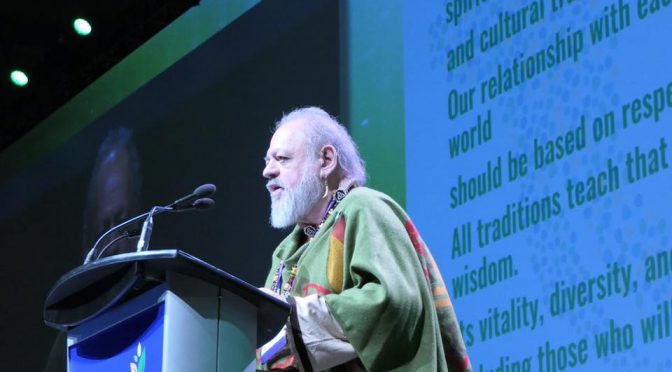
The ECER mourns the passing of Vlassis G. Rassias, one of our founders and a member of our Board of Directors. Vlassis, the leader of the Supreme Council of Ethnic Hellenes (YSEE), was renowned as an author, speaker, and activist for the restoration of the Hellenic ancestral religion, as well as an advocate for other indigenous, ethnic religions throughout Europe. I grieve, personally, the loss of a dear friend and colleague, someone whom I deeply appreciated, respected and admired throughout the decade we worked together. This is a photo of Vlassis addressing the Parliament of the World’s Religions in Toronto, Canada last November, as part of a panel discussion that he, Inija Trinkuniene of Lithuania, and I presented there. On behalf of the ECER, I send our deep condolences to his family and community — we are all so much richer for having had Vlassis as part of our lives.

Andras Corban-Arthen
President, European Congress of Ethnic Religions

May the earth rest lightly on you, Vlassis RASSIAS

Sit tibi terra levis, Vlassis Rassias

This morning a mate and long-standing friend informed us that Vlassis Rassias, the head of the big heathen community of Greece YSEE (Ellenic’ Council) is passed away.

The news, unexpected, came like a slap.
While I’m writing i don’t know how and why he has died yet.

Immediately many memories of his strong personality and of our various meetings, happened in a time frame of veteen years, reached my mind.

Different occasions, between different people and lands, but similar at the same time, along our Europe roads.

Contacts and congresses happened pursuing a common goal: the right to the legitimacy and dignity for those seeking and nding answers and cohesion in the ancient and eternal religiousness of our respetive Ancestors.

The rst coming to my mind are the images of our last meeting, not lacking of dialectic, but always respectful and with the aim of the common good: it was in occasion of the last E.C.E.R. Congress (former W.C.E.R.) organized in Rome on April 2018 by the M.T.R. coinciding with the Foundation of Rome celebrations MMDCCLXXI a.U.c.

However our pasti is old timed.

With Vlassis, indeed, we were in touch from the beginning of the century thanks to the tireless witness of the Roman-Italic Tradition that was Salvatore Ruta, cofounder and princeps of the M.T.R. of the origins.

Through Salvatore, with Vlassiv we enstablished a very hearty connection based on mutual exchange, by virtue of the common aim of making the Religion of our Ancestors live. Actually his trip to Messina and the meeting with Ruta were for Vlassis the starting point for the development of his next productive path in the Ellenic land, with his Y.S.E.E.

Then the new technologies spread in those years, internet and the debate blogs, helped our exchanges and meetings: Vlassis on 2006 called me to concelebrate at his great event: the Prometeia, organized in Greece on the Mount Olympus, in occasion of the Summer Solstice. I embraced the invitation leading a M.T.R. delegation in the Ellenic land.

After that journey – because of the surprise of attending a Solstice celebrated by an unexpected crowd of people, men, women, erderly, children, a whole community, and because of the interesting organizational and doctrinal insights of those days with Vlassis on the Moun Olympus and in Athens – that I arrived to a method decision: time had come that we, Italian heathens, as well, came from our ivory tower and opened up to the world.

So I owe to Vlassis the turning point that i gave to the M.T.R., rst one in Italy to undertake international relations.

So we take part to the W.C.E.R. congress on 2007 in Latvia, in Riga and Jurmala: even in this occasion, between the Y.S.E.E. mates and us, important af nities and strong correspondences emerged coming from the common classical culture. Then we met in Poland and, after a few years, in Lithuania, in Vilnius on 2014 and in Prague on 2016. Vlassis gave us the courtesy of a friendship visit, as well, in our hedquarters in Rome, to strengthen the ancient bond. Dear Vlassis, let me say that your long and constant work for the bene t of the current Greek and European paganism has been essential. we hope that others will know how to seize your important baton and that they will be worthy of raising the torch high, always keeping the sacred re burning. May the Gods be favourable to your new journey undertaken, and may the ground be light for you.

Daniele Liotta

MTR President
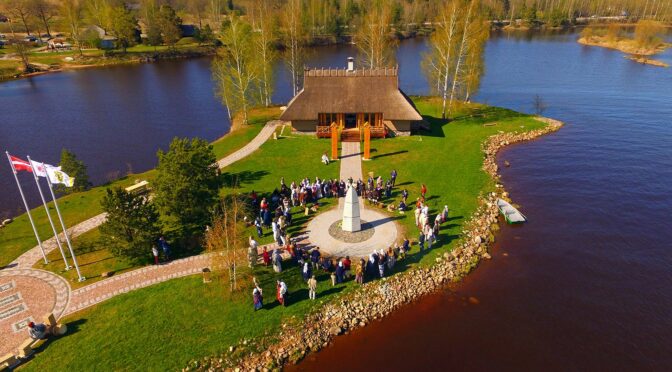
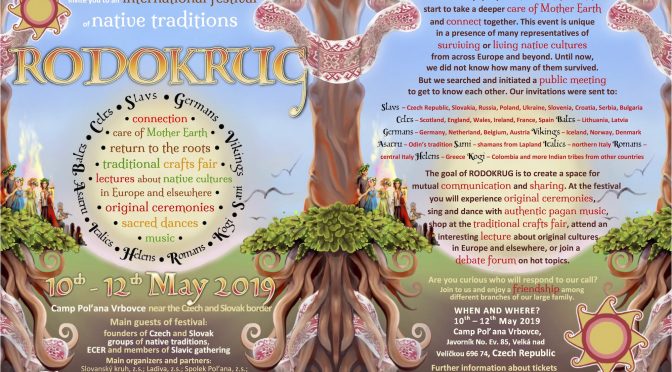
An invitation to Rodokrug – an international festival of native traditions

Please, accept our invitation to the RODOKRUG – a meeting of people, Earth and traditions of all nations.

The planet Earth calls us and wants us to think about what we are going to give to our children. If your ancestors spoke to you and you feel their voice in your hearts, then come. We will connect our forces in a united circle with our songs, prayers, dances and acts of wisdom.

The key is a connection between man and the planet. Our native traditions and their people. They teach us about values like Man, Nature, Family, LOVE, connection with sacred powers and mutual friendship. Our gods and ancestors protect us on our journey.

Please, accept this invitation to the new festival Rodokrug – a space, created for sharing our native traditions, which were passed to us by our dear ancestors.

We are inviting you, because:

  • –  We need to discuss and find a way TOGETHER. Hand in hand, with open hearts.
  • –  We wish to share the wisdom of our ancestors, our wonderful native TRADITIONS.
  • –  We are creating a space, where you can meet representatives of other tribes fromEurope and other continents, who have kept their traditions until today.
  • –  It is time to share our deep values and restore the sacred power, connecting our nations.It is the power of our Earth, and we can pass this sacred connection to our future generations, too.

Come, and if you can, bring your TRADITIONS, CEREMONIES and RITUALS, SONGS and DANCES – which you carry inside yourselves. Let’s share them with each other. Come and talk to people at a lecture. Or come to support this meeting just with your very presence. Everyone is welcome.

Together we will find the key to a happy life in a family, community and connection of the spirit and universe.

We are looking forward to meeting you.

The RODOKRUG festival will be held from 10th to 12th of May 2019. The place of meeting is Camp Pol’ana Vrbovce near the Czech and Slovak border.

We are all one circle, one family, and our roots touch each other.

SLAVA and thanks to our native gods, Mother Earth, ancestors and powers of Nature.

On behalf of the whole team of RODOKRUG festival Zdenek Ordelt, leader of the festival organization.

Web: https://www.rodokrug.com
FB: https://www.facebook.com/rodokrug

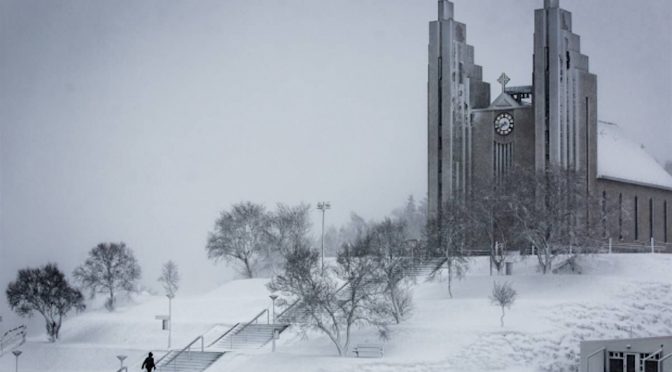
Icelanders abandon National State Church, as old pagan Ásatrú continues to grow

Republished from Icelandmag.is

The National Church of Iceland continues to lose congregants. The latest data on religious registration from Registers Iceland reveals that the church lost 2,029 members during the first nine months of 2018. The State Church is the only of the five largest religious congregations to lose members this year.

Continue reading Icelanders abandon National State Church, as old pagan Ásatrú continues to grow

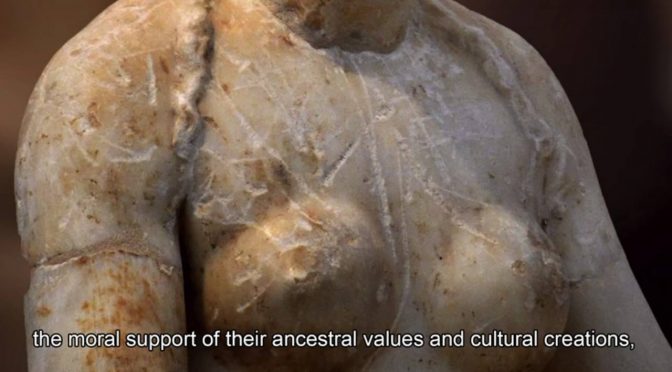
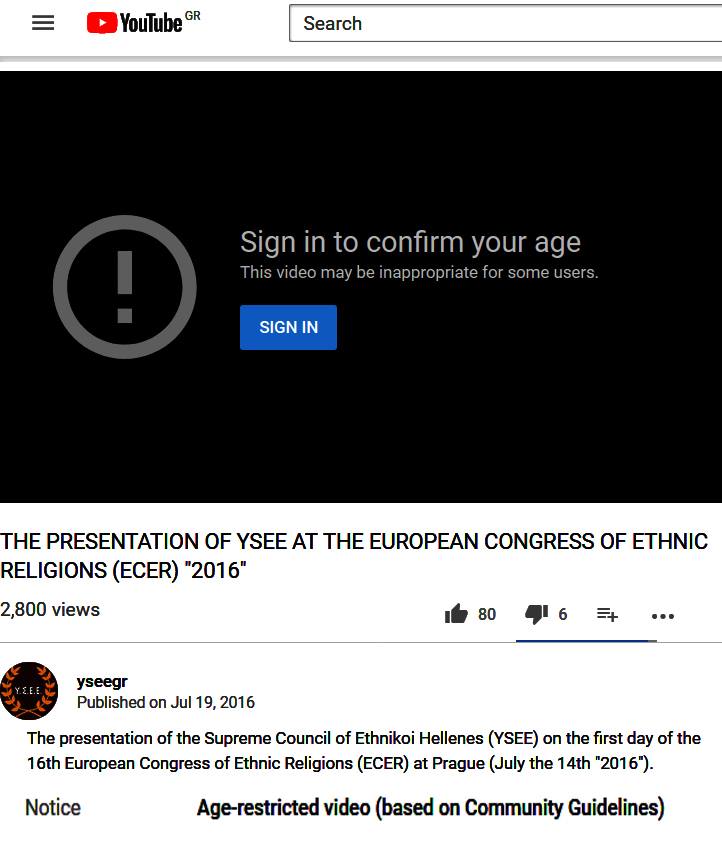
YOUTUBE DECIDED HELLENISM IS UNSUITABLE FOR MINORS!

Press Release 346 /February 1, 2018

The morally, religiously and culturally bankrupt Monotheism, is desperately clinging to life by conjuring up from its dark past the most disgusting aspects that its intolerant nature has to display. Its Islamic branch by use of military force is trying to bring humanity back to a period of medieval barbarity, while the Christian branch is attempting the same but with a preference to the 16th Century, the time of the Puritan Age.

With the incitement of fundamentalists, in country after country, those that exhibit a sick hatred for the human form, attack anything that glorifies it. Because the Greek art of the pre-Christian period and the Neoclassicism of the 19th Century that emulated it, above all others glorified the human body, they have become the main target of the monotheists. These attacks come in various guises, hiding behind the seemingly innocent masks of modernism, feminism etc…, or directly under the banners of fundamentalism and conservatism.
Continue reading YOUTUBE DECIDED HELLENISM IS UNSUITABLE FOR MINORS!